





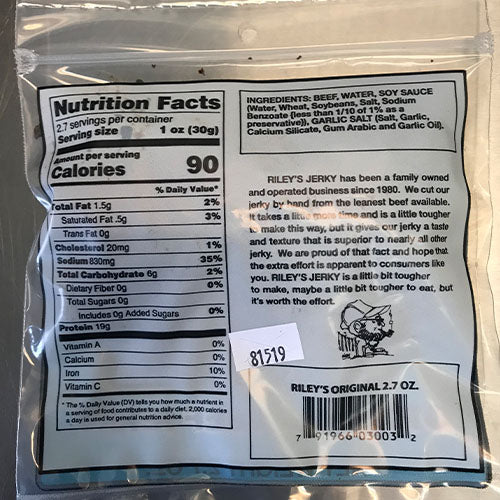

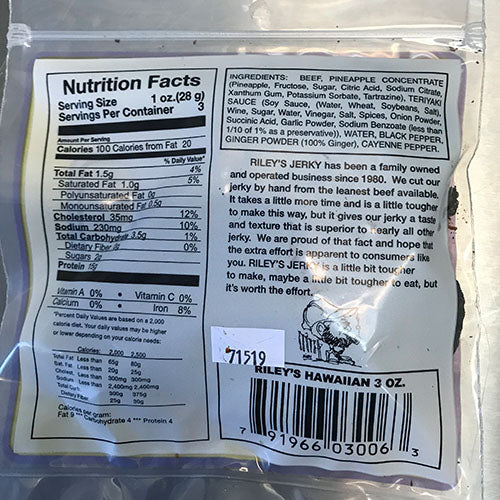

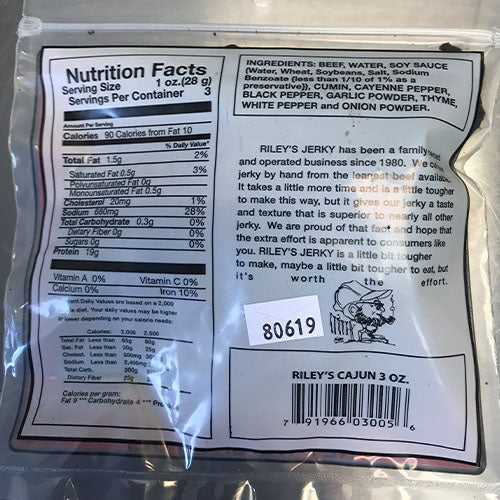
About Riley's Jerky
Most jerky brands have an origin story; Riley's Jerky has an invoice. The brand dates its first official invoice to January 23, 1980, describes itself as a family-owned business since 1980, and names 1981 as the year Riley Burkholder founded Riley's Jerky. Its beef jerky plant is in Greenville, California, a small mountain town in Northern California that the brand says is far from the big-city atmosphere. Riley's Jerky thanks its local customers for the business's start and says it has grown steadily every year since. Ownership has stayed in the family: Kaley Bentz, Riley's grandson, purchased the business from Britt Burkholder, Riley's son, and Bradley Bentz, Riley's son-in-law. Today the brand runs with a small staff of six and says it is important that the business stays family-owned-and-operated. The home page sums it up with a 44-years-family-business badge.
What makes Riley's Jerky different
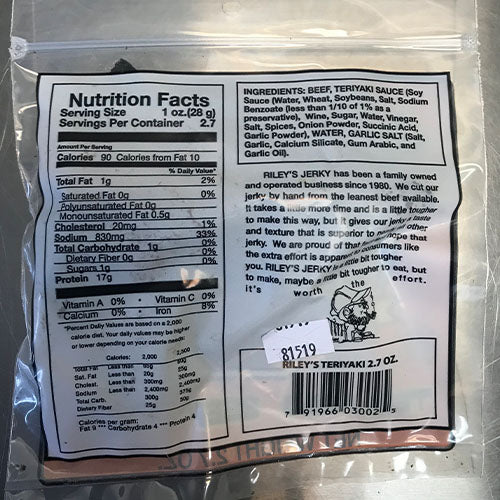
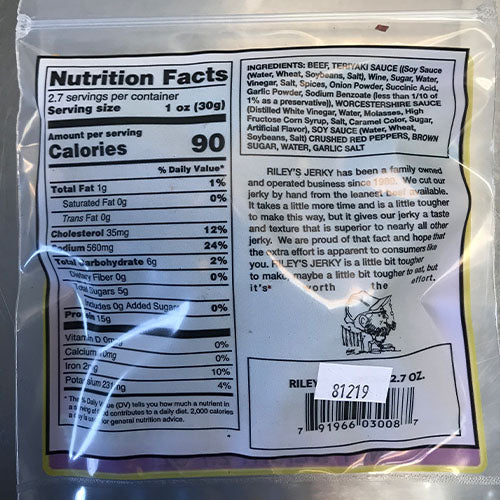
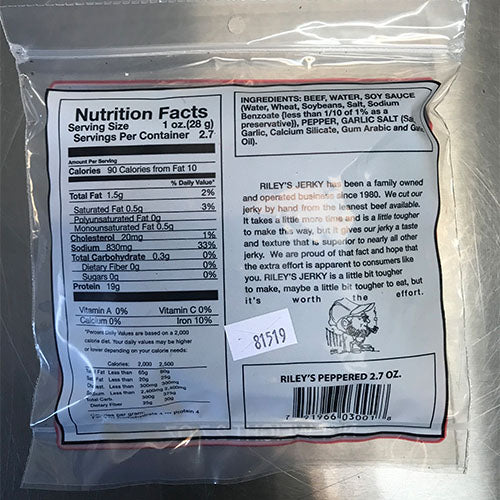
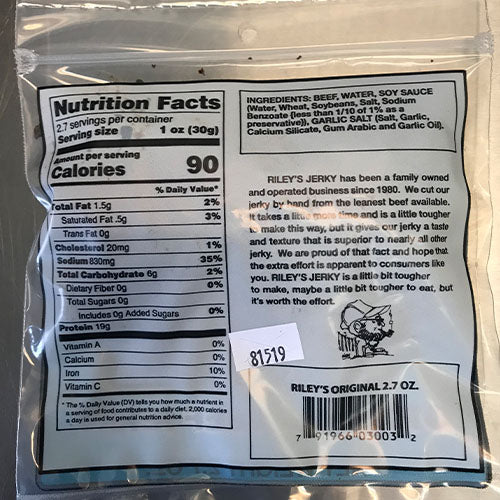
Every piece is hand cut from solid pieces of whole muscle beef, which Riley's Jerky says gives each piece a thick, homemade style. The brand pairs that cut with a long overnight marination, then dries the meat slowly for 20 hours before it is packaged. It uses only naturally grown spices and adds no preservatives to its recipes, with one caveat it states itself: the soy sauce and teriyaki sauce it uses contain a small amount of sodium benzoate, less than one-tenth of one percent. The company says there is no MSG or sodium nitrite. The payoff, in the brand's own framing, is natural-style jerky like homemade, filling enough that even the smallest bag is a meal rather than a snack. Riley's Jerky also notes the jerky holds its texture and flavor for about four months before it begins to fade.
Riley's Jerky flavors we carry
Everything in this range is beef, and nearly every flavor rides on either a soy sauce marinade or a teriyaki one. If you reach for pepper first, the peppered beef jerky is made with ground black pepper over the soy sauce base, and the brand bills it as heat and great flavor in combination. The jalapeno uses ground jalapeno peppers in that same soy sauce marinade, billed as jalapeno flavor that stops short of too hot to eat. The Cajun style gets a special blend of Cajun spices, cayenne pepper included, and sits comfortably next to the other Cajun-seasoned beef jerky on the site. On the teriyaki side, the teriyaki-style beef jerky is made with a hint of sugar and a splash of wine, while the Hawaiian adds pineapple, ginger and cayenne pepper to a teriyaki base, which the brand calls a little bit of Hawaii on the mainland. The original and the sweet & spicy carry no description on the manufacturer's site, so there is no heat called out for either; if you want to compare the latter with its peers, browse the sweet and spicy beef jerky collection, and the full hand-cut and whole-muscle beef jerky range is one click away. Everything currently in stock is in the grid above.
Who it's for
By the brand's own descriptions, heat here is measured rather than punishing: the jalapeno is positioned as not too hot, the peppered as heat with flavor, and cayenne appears in the Cajun style and the Hawaiian. If you like a thick, chewy piece you can work on rather than a thin crisp one, the hand-cut whole-muscle style is the draw. Most flavors are built on soy sauce or teriyaki sauce, so if you avoid soy, read the ingredient panel on each bag rather than assuming one flavor's list covers the rest. The manufacturer makes no gluten-free, keto or other dietary claims on its site, so you shouldn't either.
JerkyBrands is an independent retailer; the Riley's Jerky name and logo are trademarks of their owner.
